
Coffee vs. Drinks vs. Dinner: The Best First Date Format for Your Goals
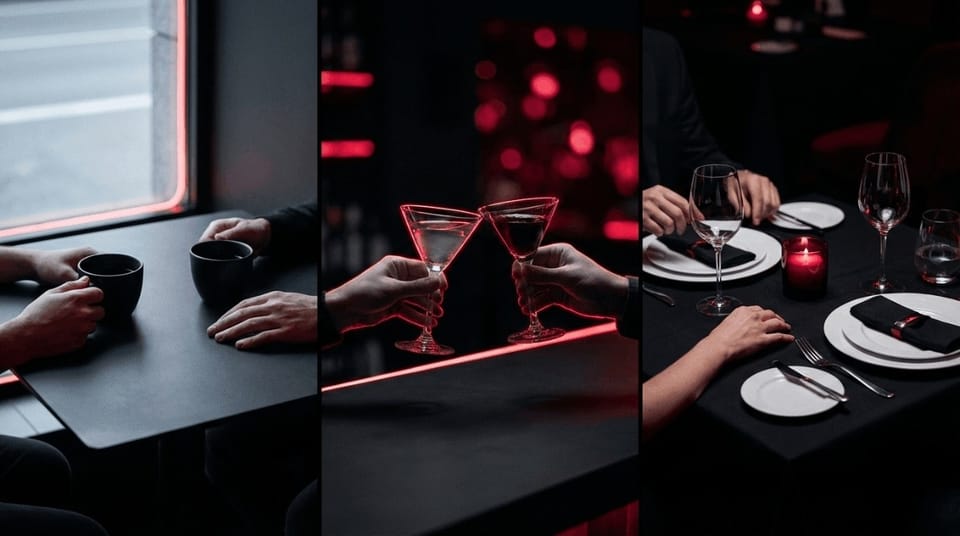
You matched. You messaged. You decided to meet.
Now comes the question nobody talks about enough:
Where do you actually go?
Most people default to one of three options—coffee, drinks, or dinner—without thinking strategically about which format serves their actual goal. The result? A date format that works against them before they've even sat down.
Coffee dates feel too casual for some, too low-effort for others. Dinner feels too formal, too expensive, too much pressure. Drinks land somewhere in the middle but carry their own complications.
The truth is: there's no universally "best" first date format. There's only the best format for your specific situation, goal, and the person you're meeting.
This guide breaks down every dimension of the coffee vs. drinks vs. dinner debate—cost, time investment, psychological dynamics, success rates, gender dynamics, app-specific nuances, and the decision tree that helps you choose correctly every time.
By the end, you'll never default-pick a venue again.
Why First Date Format Matters More Than You Think
Most people treat venue selection as a logistical afterthought. It's not. The format of your date shapes:
1. Expectation Alignment
A dinner invitation signals serious interest. A coffee invitation signals casual exploration. When your format doesn't match your intent, you create mismatched expectations before you've even met.
Mismatch scenario: You suggest dinner because you're a generous person. They interpret it as heavy romantic investment. They arrive expecting intensity. You arrive wanting to see if there's basic chemistry. The dynamic is already off.
2. Energy and Performance Demand
Different formats demand different levels of social energy. A 90-minute coffee date is manageable. A 3-hour dinner date requires sustained conversation, performance, and engagement that can feel exhausting before it even begins.
Energy mismatch: You're introverted and suggest dinner to impress them. By hour two, you're depleted and conversation stalls. A 60-minute coffee date would have left both of you wanting more.
3. Investment and Power Dynamics
Who pays, how much, and what that signals varies dramatically by format. These dynamics create subtle power imbalances that affect how both parties feel about the interaction.
4. Escape vs. Extension Flexibility
Some formats make it easy to leave early if there's no chemistry. Others trap both people in long, uncomfortable commitments. The right format gives you graceful exit options and natural extension possibilities.
5. Alcohol and Decision-Making
Drinks dates involve alcohol. This affects conversation depth, inhibition, physical escalation, and safety in ways coffee and dinner (partially) don't.
The Complete Breakdown: Coffee
What It Is
Coffee dates typically involve meeting at a café for 60-90 minutes during daytime or early afternoon hours. Low financial investment, low time commitment, low social pressure.
The Psychology of Coffee
What coffee signals to your date:
✓ "I want to meet you, but I'm being realistic about compatibility" ✓ "I respect both of our time" ✓ "I'm not trying to impress you with money" ✓ "I'm open-minded but not desperate" ✓ "Let's see if there's something real before investing heavily"
What it can signal negatively (if poorly framed):
✗ "I don't think you're worth much effort" ✗ "I'm keeping my options open" ✗ "I'm not really that interested"
The framing determines the perception. Suggesting coffee confidently and specifically ("There's a great place on 5th I've been wanting to try. Saturday at 2?") reads very differently from "I dunno, maybe coffee sometime?"
Coffee Date: Full Analysis
Cost: $5-15 per person Duration: 60-90 minutes (natural endpoint) Alcohol involved: No Pressure level: Low Exit difficulty: Easy Extension possibility: Natural (walk after, second location) Chemistry requirement: Conversation only—no activity to hide behind Best time: Saturday or Sunday afternoon, weekday lunch
Who Coffee Works Best For
Scenario 1: High Volume Daters If you're actively dating multiple people simultaneously (as is common and healthy in early modern dating), coffee is the efficient, respectful choice. It lets you filter for genuine chemistry before investing dinner-level time and money.
Scenario 2: Introverts Coffee's low energy requirement, defined endpoint, and quiet setting makes it ideal for introverts who deplete quickly in social performance situations.
Scenario 3: App Dating (First Meeting) When you've never met in person—only talked through an app—coffee is the appropriate first format. You're not going on a "date" yet; you're confirming whether the person matches their profile and conversation.
Scenario 4: Busy Professionals Limited time windows make coffee practical. A lunch or afternoon coffee can fit into packed schedules without requiring an entire evening.
Scenario 5: Safety-Conscious First Meetings Daytime coffee in a public space is the safest first meeting format, particularly for women meeting men from apps for the first time.
When Coffee DOESN'T Work
❌ When You've Already Built Strong Chemistry If you've been messaging for weeks, had long phone calls, and both feel significant interest—coffee can feel anticlimactic. The connection has already progressed beyond "screening" level.
❌ When Your Match Has Explicitly Romantic Expectations Some people view coffee dates as dismissive. If they've expressed excitement about dinner or evening plans, downgrading to coffee signals misaligned interest.
❌ When You Want to Create Memorable Impressions Coffee shops are forgettable by nature. If creating a distinctive, atmospheric memory matters to you, coffee's neutral setting works against you.
❌ When Evening Timing Is Unavoidable Suggesting coffee at 7 PM is strange. Coffee dates are inherently daytime activities. Evening chemistry requires a different format.
The Coffee Date Upgrade Technique
The built-in extension strategy:
Plan a coffee date with a walk-nearby option ready: "There's a great café at [location]—and there's a nice park two blocks away if we want to keep going."
This gives you:
- Easy exit (just coffee, 60 min)
- Natural extension (walk, adds 30-60 min)
- Second location option (creates a "two-part date" dynamic)
- No pressure to commit to longer upfront
Coffee Date: Verdict
Best for: First meetings from apps, casual screening, introverts, busy schedules, safety-conscious situations, high-volume dating
Success rate indicator: Medium for immediate chemistry creation, high for filtering genuine compatibility
Ideal relationship goal: Any—it's a starting point, not a statement
The Complete Breakdown: Drinks
What It Is
Drinks dates involve meeting at a bar, cocktail lounge, or wine bar during evening hours. Medium financial investment, flexible time commitment, social lubrication through alcohol.
The Psychology of Drinks
What drinks signals to your date:
✓ "I'm interested romantically, not just casually" ✓ "I have social confidence (bar settings require it)" ✓ "I'm open to where the evening goes" ✓ "This is definitely a date, not a 'hang'" ✓ "I'm available for evening time, which signals real interest"
What it can signal negatively:
✗ "I need alcohol to have conversations" ✗ "I'm hoping to lower your inhibitions" ✗ "I don't have enough respect to plan something more thoughtful" (if venue is poor)
Drinks Date: Full Analysis
Cost: $25-60 per person (venue-dependent) Duration: 90 minutes to open-ended Alcohol involved: Yes—double-edged factor Pressure level: Medium Exit difficulty: Medium (socially easier to leave after first drink) Extension possibility: High (dinner after, second bar, other activities) Chemistry requirement: Conversation + physical chemistry accelerated by alcohol Best time: Friday or Saturday evening, 7-9 PM
The Alcohol Factor: Double-Edged Sword
Potential benefits of alcohol on first dates:
- Reduces social anxiety (for both parties)
- Lowers conversational inhibition (more honest, natural interaction)
- Accelerates comfort (can create intimacy faster)
- Provides natural talking point ("What are you drinking? I'd recommend the...")
- Evening atmosphere (different energy than daytime, more romantic)
Potential risks of alcohol on first dates:
- Blurs decision-making (consent, safety, over-sharing)
- Creates false intimacy (chemistry that disappears sober)
- Financial escalation (rounds add up quickly)
- Behavior revelation (how someone drinks reveals character)
- Safety concerns (vulnerability increases with intoxication)
- Dependency signal (if you need alcohol to connect, that's data)
The 2-Drink Rule:
Research suggests 1-2 drinks creates the social lubrication benefit without the impairment risk. Know your limit before you arrive and stick to it regardless of their pace.
Who Drinks Works Best For
Scenario 1: Clear Romantic Intent If both parties are explicitly looking for romantic connection (not just friendship testing), the evening drinks setting signals that clearly.
Scenario 2: People Who've Already Chatted Extensively If you've been messaging for weeks and already established chemistry, drinks allows you to build on existing connection in a romantic setting.
Scenario 3: Extroverts and Social Naturals Bar environments reward social energy and easy conversation. Extroverts thrive here.
Scenario 4: Urban Dating Culture In cities like New York, London, or LA, evening drinks are the default first date format in certain social circles. Suggesting coffee can actually signal less confidence in these contexts.
Scenario 5: When You Want Physical Chemistry to Emerge Naturally Evening atmosphere, alcohol's light disinhibition, and bar seating proximity create conditions for natural physical escalation. If physical chemistry is important to you early, drinks facilitates this.
When Drinks DOESN'T Work
❌ For Non-Drinkers or Sober People Obvious but important. If either party doesn't drink, a bar setting is awkward at best. Always ask about this before suggesting drinks.
❌ For Safety-Conscious First Meetings Evening + alcohol + strangers = elevated risk. For first meetings, particularly from anonymous app matching, the safety calculus shifts.
❌ For People with Alcohol Issues If you're in recovery or managing a complicated relationship with alcohol, bar settings create unnecessary friction.
❌ When You Want Deep, Substantive Conversation Bars are loud. Depth requires quiet. If your goal is getting to know someone meaningfully, bar noise actively works against you.
❌ With Someone Who Expressed Preference for Something Else If they've mentioned they don't drink, find bars boring, or suggested alternative formats—ignoring this shows poor listening.
The Drinks Date Upgrade Technique
The dinner pivot:
After the first drink (30-45 min), if connection is strong: "Are you hungry? There's a great place two blocks away—want to continue this over food?"
Why this works:
- Low pressure (just a question)
- Natural timing (one drink in = decided they're worth more time)
- Creates multi-act date experience
- Signals escalating interest without being intense
The second location move:
"This place is getting crowded. I know a quieter bar nearby—want to check it out?"
Moving locations creates a "new date" feel within the same evening, increasing perceived time spent and investment.
Drinks Date: Verdict
Best for: Established app chemistry, clear romantic intent, extroverts, urban dating contexts, people comfortable with evening escalation
Success rate indicator: High for physical chemistry creation, medium for deep compatibility assessment
Ideal relationship goal: Romantic connection with potential for same-evening escalation
The Complete Breakdown: Dinner
What It Is
Dinner dates involve meeting at a restaurant for a full meal during evening hours. High financial investment, high time commitment, high signal of serious interest.
The Psychology of Dinner
What dinner signals to your date:
✓ "I'm seriously interested in you" ✓ "I'm generous and invested" ✓ "I respect you enough to plan a real experience" ✓ "I'm looking for something meaningful, not casual" ✓ "I'm financially comfortable and generous"
What it can signal negatively:
✗ "I'm trying to buy your affection" ✗ "I have serious/heavy expectations" ✗ "I move fast and invest heavily early" ✗ "The stakes of this date are very high" (creates pressure)
Dinner Date: Full Analysis
Cost: $60-150+ per person (venue-dependent) Duration: 2-3 hours (hard to leave early without rudeness) Alcohol involved: Often (wine with dinner) Pressure level: High Exit difficulty: Hard (trapped until meal ends + bill) Extension possibility: Medium (drinks after, walk) Chemistry requirement: Sustained conversation across multiple hours Best time: Friday or Saturday evening, 7-8 PM
The Dinner Commitment Problem
Dinner has a fundamental structural issue for first dates: you're both trapped.
Once you're seated, ordered, and eating—leaving requires an active, obvious decision. Bad chemistry + dinner = one of the most uncomfortable experiences in modern dating.
The 3 Phases of a Dinner Date:
Phase 1 - Arrival and Drinks (20-30 min): This is actually the drinks date phase. You're reading initial chemistry, making first impressions, deciding if you want to be there.
Phase 2 - Ordering and First Course (20-30 min): By now, you're committed. Chemistry is reading one way or another. Good: you settle into it. Bad: you have 90 more minutes to get through.
Phase 3 - Main Course to End (45-60 min): Full commitment phase. Conversation must sustain. Energy must hold. Good dates feel like they end too quickly. Bad dates feel eternal.
The harsh reality: If chemistry isn't there by Phase 1, dinner makes you both endure Phases 2 and 3 anyway.
Who Dinner Works Best For
Scenario 1: Known Chemistry You've met before (work, social circle, mutual friends), already established chemistry, and the date is a formal "yes this is romantic" progression. Dinner is appropriate here because you're not screening—you're building.
Scenario 2: Established App Connection You've been messaging for 4-6+ weeks, had phone calls or video dates, and both feel strong mutual interest. You've earned dinner-level investment.
Scenario 3: Mature Daters With Serious Intent Divorced, widowed, or older daters often prefer dinner's seriousness as a signal of genuine romantic intent rather than casual exploration.
Scenario 4: Special Occasion First Dates Set-ups through trusted mutual friends, blind dates with strong endorsement, or situations where both parties have already expressed significant interest.
Scenario 5: When They've Explicitly Expressed Preference If they've mentioned specific restaurants, love food, or suggested dinner themselves—meet that energy.
When Dinner DOESN'T Work
❌ Cold App Matches (Never Met Before) Meeting a stranger from an app for dinner is the single highest-risk first date format. High investment, high pressure, no escape route, unknown chemistry. This is almost universally too much for a first interaction.
❌ When You're Uncertain About Compatibility If you're dating multiple people or not sure about this specific match—dinner commits too much before earning it.
❌ Budget Concerns on Either Side If cost creates imbalance or discomfort (who pays? can they afford to reciprocate?), dinner introduces financial dynamics that complicate the date.
❌ When One Person Is Intimidated by Formal Settings Fancy restaurants create performance anxiety for some people. If your date seems more comfortable in casual settings, you're optimizing for the wrong thing.
❌ First Meeting After App Matching Repeat for emphasis: Don't do dinner for a first app meeting. The risk-to-reward ratio is terrible. Coffee or drinks first, dinner when you know you like each other.
The Dinner Date Success Framework
If you're doing dinner, do it right:
Venue Selection:
- Choose somewhere you've been before (no navigation anxiety)
- Book in advance (shows planning)
- Mid-upscale, not intimidatingly expensive
- Quiet enough for real conversation (under 70 decibels)
- Good food (obviously)
Reservation Etiquette:
- Make one. Not optional.
- Book under your name
- Confirm 24 hours before
- Arrive 5-10 minutes early
The Pre-Dinner Drinks Option: Suggest drinks at a nearby bar 30 minutes before dinner reservation: "The reservation's at 7:30. Want to meet at [bar] at 7 for a drink first?"
This adds a phase buffer: if chemistry is clearly missing after the drink, you have an exit point before dinner. If it's great, you're already warmed up and excited for the meal.
The Payment Question at Dinner
The high-stakes check moment:
Dinner's higher cost makes the payment question more loaded than coffee or drinks.
Contemporary approach: Whoever initiated the date should offer to pay. The other person should offer to split or contribute. The initiator can graciously accept or insist.
What to say: "I've got this one—you can get the next one." (Assumes second date, signals generosity, creates reciprocity expectation)
If they insist on splitting: Let them. Don't make it a power struggle. Their comfort matters more than the gesture.
What NOT to do:
- Expect payment based on gender
- Make the bill awkward with lengthy back-and-forth
- Create obligation ("I paid for dinner, so...")
- Never offer at all
Dinner Date: Verdict
Best for: Established chemistry, serious romantic intent, known connections, mature dating, special occasion firsts
Success rate indicator: High when chemistry is already established, low when used as a screening mechanism
Ideal relationship goal: Serious relationship potential, confirmed mutual interest
The Head-to-Head Comparison
The Decision Tree: Which Format Is Right for You
Step 1: How Did You Meet?
Dating App (Never Met In Person) → Go to Step 2
Real Life (Social circle, work, mutual friends) → Skip to Step 4
Dating App + Already Had Phone/Video Call → Go to Step 3
Step 2: App Match, First Ever Meeting
How long have you been messaging?
Under 2 weeks: → COFFEE. Always. You don't know this person. Invest appropriately.
2-4 weeks with solid conversation: → COFFEE or DRINKS (your preference, their comfort with evening meeting)
4+ weeks, long conversations, clear chemistry: → DRINKS (you've earned more than coffee, dinner is still premature)
Never do dinner for a first app meeting with someone you haven't spoken to beyond text.
Step 3: App Match + Phone/Video Call History
How did the call go?
Great call, clear chemistry, both excited: → DRINKS (you've established connection, evening investment is appropriate)
Good call, decent chemistry, want to confirm in person: → COFFEE or DRINKS (either works, choose based on your energy and timing)
Okay call, uncertain chemistry: → COFFEE (filter before investing)
Step 4: Real Life Connection
How well do you know them?
Met once, minimal interaction: → COFFEE or DRINKS (still relative strangers despite real-world meeting)
Multiple interactions, clear mutual interest: → DRINKS or DINNER (established context supports more investment)
Close orbit (work, social circle), clear chemistry: → DINNER (appropriate signal for established connection, stakes are understood)
Step 5: What's Your Goal?
Just exploring, keeping options open: → COFFEE (low investment matches low certainty)
Looking for serious relationship: → DRINKS or DINNER (depending on connection level)
Physical chemistry important early: → DRINKS (evening, alcohol, proximity)
Deep connection before physical: → COFFEE (conversation-only setting)
Both: → DRINKS (covers both bases)
Step 6: External Factors
They don't drink: → COFFEE or NON-ALCOHOLIC DINNER (never a bar)
Budget is tight: → COFFEE (never compromise financial comfort for impression)
Safety is a concern: → COFFEE, daytime, public (always)
They suggested a specific format: → That format (respect their preference)
You're introverted and low-energy: → COFFEE (protect your energy investment)
Beyond the Three: Alternative First Date Formats
Sometimes coffee, drinks, and dinner aren't the right answer at all.
Activity Dates
What they are: Museums, galleries, cooking classes, mini golf, bowling, escape rooms, markets, botanical gardens
Best for:
- People who get nervous in pure conversation settings
- Matching interests (she mentioned she loves art → museum)
- Creating memorable experiences
- Building connection through shared experience
Cost: $15-50 typically Duration: 90-120 minutes Chemistry requirement: Lower (activity does some work) Conversation requirement: Natural and contextual
The activity date advantage: Side-by-side activities reduce eye contact pressure, provide natural conversation topics, create shared memories, and reveal personality through action rather than performance.
Best activity first dates:
- Art gallery or small museum (quiet, interesting, walkable)
- Farmers market (casual, fun, food tasting)
- Botanical garden (beautiful, peaceful, natural)
- Cooking class (collaborative, tactile, fun)
- Mini golf or bowling (playful, competitive, revealing)
- Food hall exploration (sampling, low commitment, moveable)
Avoid for first dates:
- Movies (no talking, two hours of silence)
- Concerts (too loud for connection)
- Extreme sports (too much adrenaline, safety concerns)
- Theme parks (exhausting, too long, too expensive)
The Walk Date
What it is: A purposeful walk through a park, waterfront, neighborhood, or scenic area
Best for:
- Introverts who find face-to-face pressure intense
- Good weather situations
- Building comfort through movement
- Low-cost, low-pressure first meetings
The walk date psychology: Side-by-side reduces eye contact intensity, movement releases endorphins that create positive association, and walking direction gives natural conversation breaks.
Combine with: Coffee before or ice cream after for a complete low-investment date structure
Cost: Free to $10 Duration: 45-90 minutes (your pace)
The Daytime Activity + Coffee Combo
The structure: Activity (60 min) → Coffee or drink after (45-60 min)
Example: Farmers market (45 min) → Coffee at nearby café (45 min)
Why this works:
- Activity breaks ice and creates talking points
- Coffee after allows deeper conversation
- Two-part structure feels like a longer investment without the dinner commitment
- Natural exit after coffee if chemistry doesn't develop
Common First Date Format Mistakes
Mistake 1: Defaulting Without Thinking
Most people suggest coffee or dinner purely from habit. Spend 30 seconds thinking about what this specific situation actually calls for before defaulting to your go-to.
Mistake 2: Dinner for App First Meetings
This deserves repeating. Never suggest dinner as a first meeting with someone you haven't spoken to beyond text. The investment mismatch alone creates problems before you've met.
Mistake 3: Letting Them Decide Everything
"Where do you want to go?" signals indecisiveness, puts all planning burden on them, and removes your opportunity to create the optimal chemistry conditions.
Better: "I'm thinking [coffee shop/bar/restaurant]. Does that work for you?"
Best: "There's this great [place] on [street]. Saturday at [time]?"
Mistake 4: Overdoing the Venue
An overly fancy restaurant for a first date creates:
- Financial pressure (who pays this?)
- Performance anxiety (living up to the setting)
- Obligation feeling (they spent how much?)
- Mismatch with casual getting-to-know-you phase
First dates don't need to be impressive. They need to be comfortable.
Mistake 5: Ignoring Their Preferences
If they mention they don't drink, suggesting a bar ignores them entirely. If they suggest a format, dismissing it shows you don't listen. Pay attention to their communication for clues about what they'd enjoy.
Mistake 6: Wrong Time of Day for Format
- Coffee at 8 PM: Strange
- Dinner at 11 AM: Strange
- Drinks at 10 AM: Strange
Match your format to its natural time context.
Mistake 7: Choosing Loud or Chaotic Venues
A first date's primary job is creating conditions for connection. Loud venues prevent conversation. Chaotic venues prevent focus. Always choose venues where you can hear each other comfortably.
Decibel test: If you have to raise your voice to be heard, it's too loud.
Mistake 8: No Backup Plan
What if the café is closed? What if there's a 45-minute wait? Always have a backup venue in the same area so you're not fumbling with your phone looking for alternatives in front of your date.
How to Suggest the Date Format (The Invitation Scripts)
Coffee Invitation Scripts
Confident and specific: "There's a great coffee shop on [street] I've been wanting to try. Are you free Saturday afternoon?"
Casual and direct: "Want to grab coffee this weekend? I know a quiet spot near [neighborhood]."
With built-in extension option: "Coffee Saturday? There's a good place near [park] so we could walk after if it's nice out."
Drinks Invitation Scripts
Direct and romantic: "I know a great bar in [neighborhood]. Are you free Friday or Saturday evening?"
Specific venue: "Have you been to [specific bar]? Great atmosphere. Thursday evening?"
With dinner pivot option: "Want to grab drinks Friday? I know a good bar near some great restaurants if we want to continue."
Dinner Invitation Scripts
Warm and intentional: "I'd love to take you to dinner. There's a restaurant I've been wanting to try—are you free Saturday?"
Specific and planned: "I made a reservation at [restaurant] for Saturday at 7:30. Would you like to join me?"
With pre-dinner drinks option: "Dinner Saturday? There's a great bar nearby—we could meet there at 7 before the reservation at 7:30."
Activity Date Invitation Scripts
Interest callback: "You mentioned you love [art/cooking/markets]. There's a [gallery/cooking class/market] this weekend—want to check it out?"
Playful and specific: "I have an important question: how's your mini golf game? Because I challenge you to an embarrassing first date loss. Sunday?"
Low pressure: "Want to check out [farmers market/botanical garden] Saturday morning? We can grab coffee after."
The Format-to-Relationship-Goal Alignment Chart
If Your Goal Is: Casual Dating / Keeping Options Open
Best Format: Coffee or low-key activity Why: Investment matches uncertainty. No misleading signals about seriousness.
If Your Goal Is: Serious Relationship
Best Format: Drinks (first app meeting) → Dinner (second or third date) Why: Shows genuine interest without premature over-investment.
If Your Goal Is: Physical Connection
Best Format: Drinks (evening, alcohol, proximity) Why: Evening atmosphere and light disinhibition create conditions for physical chemistry.
If Your Goal Is: Deep Emotional Connection
Best Format: Coffee or daytime activity Why: Sober, calm, conversation-focused setting enables real intimacy.
If Your Goal Is: Testing Compatibility Efficiently
Best Format: Coffee (low investment, easy exit, good conversation test) Why: 60 minutes of good conversation reveals more than 3 hours of dinner performance.
If Your Goal Is: Creating a Memorable Experience
Best Format: Unique activity date Why: Shared novel experiences create stronger memories than static sitting.
The Progression Strategy: How Format Should Evolve
Healthy first-date progression for app dating:
Date 1: Coffee or drinks (screening, initial chemistry) Date 2: Activity or drinks (confirmed interest, building connection) Date 3: Dinner (established chemistry, serious investment) Date 4+: Any format that fits the developing relationship
Why this progression works:
Each escalation in format signals increasing investment, which mirrors the natural progression of genuine interest. Jumping to dinner on Date 1 skips the progression and creates pressure. Moving through it naturally builds anticipation and trust simultaneously.
The Anticipation Principle:
Leaving someone wanting more is more powerful than giving everything upfront. A great 60-minute coffee date that ends at the right moment creates more anticipation for the second date than a 3-hour dinner that runs out of steam.
Remember This: Format Is the Container, Connection Is the Content
You can have a life-changing connection over terrible coffee in a mediocre café. You can have a forgettable evening at the best restaurant in the city.
Format matters—but it's not everything.
The goal of the first date format is to create the optimal conditions for connection to develop. Beyond that, what you bring to the table—your presence, your listening, your authenticity, your humor, your curiosity—matters infinitely more than the venue.
Choose your format strategically. Then forget about it completely.
Be present. Be genuinely curious. Listen more than you talk. Show up as your authentic self.
The right person will connect with you over bad coffee, cheap drinks, and mediocre pasta.
The wrong person won't connect regardless of the Michelin stars.
Choose wisely. Show up fully. Let the rest happen.
Smart Venue Choice Is Just the Start-Let AI Handle the Rest
You've chosen the right format. You've picked the venue. You've confirmed the time.
Now comes the part that actually determines whether there's a second date: the conversation.
And here's the thing about conversations on first dates—they're happening in real time, with a stranger, under low-key pressure, while you're also managing your nerves, reading their signals, deciding if you're attracted, and trying to seem naturally charming.
That's a lot of cognitive load.
DatingX takes the mental load off so you can actually be present.
How DatingX Prepares You for Any Format:
📸 Flirty Opener Generator: Whether you matched on Hinge, Bumble, or Tinder—upload their profile photo and get personalized, high-converting openers that start the conversation right, setting you up for a date worth having.
🔍 Chat Decoder: Before your coffee, drinks, or dinner date, paste your conversation history into DatingX. Get a read on: What topics they're most engaged by (bring these up on the date), their communication style (so you can calibrate yours), their level of interest (so you know how much to invest in the venue), and any signals you might have missed.
💬 Convo Replier: After the date, when you're figuring out the follow-up text, DatingX suggests responses calibrated to how the date went and their communication patterns—so you don't lose momentum on a great coffee date because your text was too vague.
🎙️ Virtual Date Simulation: Nervous about conversation stalling over dinner? Anxious about what to talk about over drinks? Practice with DatingX's voice-based AI simulator. Run through topics, practice your openers, work through your anxiety—before you walk through the door.
The Format + AI Advantage:
Choosing the right format gets you in the room. DatingX helps you make the most of every minute once you're there.
Whether it's a 60-minute coffee or a 3-hour dinner, show up prepared, present, and confident.
👉 Download DatingX and 10x your dating game.
Frequently Asked Questions
Q 1: Is coffee too casual for a first date? A: Coffee is only too casual if it's framed casually. Suggesting a specific, quality café at a defined time signals thought and intention. Coffee is the ideal format for first meetings from dating apps, introverts, busy schedules, and safety-conscious situations. It's inappropriate only when chemistry is already established and both parties are clearly expecting a more invested meeting. When in doubt, coffee is the safer, smarter choice.
Q 2: Should you do dinner on a first date? A: Only if you already know you like each other. Dinner is appropriate when you've met in real life, spoken on the phone, or had multiple extended conversations that confirmed mutual chemistry. For first app meetings with strangers, dinner creates high pressure, expensive investment, and no easy exit if chemistry is absent. The better progression is coffee or drinks first, dinner on the second or third date once interest is confirmed.
Q 3: Who should pay on a first date? A: The person who initiated the date should offer to pay, regardless of gender. The other person should offer to split or contribute. For coffee, splitting is completely normal and low-stakes. For drinks, the inviter paying for the first round is a common social courtesy. For dinner, whoever initiated should offer to cover it, with the option to split if the other person insists. The key is making the moment graceful rather than awkward—say "I've got this one" without fanfare.
Q 4: Is a drinks date better than coffee for creating romantic chemistry? A: Yes, in most circumstances. Evening timing, ambient atmosphere, and light alcohol consumption create conditions more conducive to romantic chemistry than daytime coffee. However, drinks require confirmed sobriety safety, work best for extroverts, and can create false intimacy if alcohol is doing the heavy lifting. If you're meeting someone for the first time from an app, coffee is safer. If you've established connection and want to advance it romantically, drinks are appropriate.
Q 5: What's the best first date idea that isn't coffee, drinks, or dinner? A: Activity dates. Museums, art galleries, farmers markets, botanical gardens, cooking classes, and walking tours all create shared experiences that reduce conversation pressure, reveal personality through action, and create memorable moments that static sitting doesn't. The best activity date references something they mentioned being interested in—showing you listened. Follow any activity with coffee or a drink after for deeper conversation once the ice is broken.